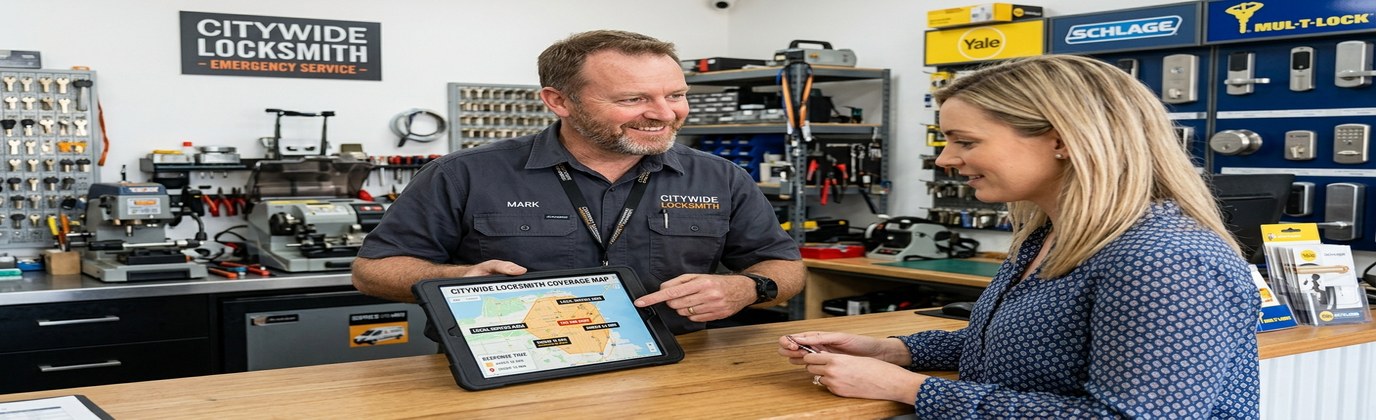
FAQ page hero for nearby locksmith proximity questions

Nearby Locksmith FAQ: 20 Questions Answered

Direct answers to the most common questions about finding a locksmith close to you, from response time and service radius to licensing and pricing.

The most important question: "What is your ETA in minutes to [my exact address]?" That one question gives you more useful information than any proximity metric on a map.

Response Time and Distance

  • Is the closest locksmith always the fastest to arrive?
    No. Job load, traffic, and parking affect arrival time more than raw distance in most urban and suburban scenarios. A locksmith with a free technician 4 miles away will typically arrive faster than one finishing a job 0.5 miles from you. Always ask for an ETA in minutes to your specific address, not a distance on a map.
  • How do I get an accurate ETA?
    When you call, give your complete address including apartment number, any parking notes (gated, garage, street only), and what floor you're on. Then ask: "How many minutes until your technician can be at that address?" A dispatcher who cannot answer with a specific window is either unavailable or not being straight with you.
  • What is a typical service radius for a locksmith nearby?
    Urban markets (NYC, SF, Chicago): 1-3 miles per operator. Suburban markets (Houston suburbs, Phoenix, Atlanta outskirts): 8-20 miles. Rural and semi-rural: 25-60 miles. The radius expands with lower population density because there are fewer competing operators and each covers more territory. Your Google search showing "nearby" results does not guarantee those operators dispatch to your exact address.
  • Does traffic significantly affect locksmith response time?
    Yes, especially in dense urban areas. A 2-mile drive in Manhattan during rush hour can take 30-45 minutes. The same trip at 10pm takes 8 minutes. Ask the dispatcher if they account for current traffic in their ETA, and whether their technician is driving toward you or away from you at the moment you call.
  • Does parking affect when a locksmith arrives at my door?
    Yes. In dense urban settings, a locksmith who arrives at your building address may take an additional 5-20 minutes to find legal parking and physically reach your unit. Provide building access details upfront: parking structure, entry code, which elevator bank, which buzzer to ring. Reduce unknown delays by giving all context when you first call.

Licensing and Verification

  • What states require locksmith licensing?
    As of 2026, states with locksmith licensing requirements include California (BSIS), Texas (TDLR), Louisiana, Illinois, New Jersey, Nevada, North Carolina, Oklahoma, and Virginia, among others. Requirements vary by state and some cities have local ordinances that go further than state law. In unlicensed states, look for ALOA (Associated Locksmiths of America) membership as a voluntary quality credential.
  • How do I verify a BSIS license in California?
    Go to bsis.ca.gov and search by license number or business name. A valid BSIS license shows as Active with an expiration date. If the number they give you returns expired, suspended, or Not Found, do not proceed. Ask the technician to show their physical license card on arrival.
  • Can a locksmith nearby work without a license?
    In licensed states, operating without a license is illegal, regardless of proximity. An unlicensed locksmith nearby is more problematic than a licensed one 10 miles away. You have no consumer recourse through state licensing boards with an unlicensed operator, and their work may not be bonded or insured.
  • Does proximity reduce licensing requirements?
    No. A locksmith 0.2 miles from you is subject to the same licensing requirements as one 25 miles away. Distance has no bearing on professional requirements. All locksmiths working in California must hold a BSIS license; all working in Texas must hold a TDLR license; etc.

Pricing and Trip Fees

  • What is a service call fee and when is it charged?
    A service call or dispatch fee is a flat charge for sending a technician to your location, separate from labor and parts. It typically ranges from $25 to $75 for in-service-area calls. Rural or out-of-area calls can have trip fees of $50-$150 or more. Always ask: "Is there a service call fee for my address, and is that included in the total price you just quoted me?"
  • Are rural locksmith prices higher than urban?
    Generally yes, because travel time and fuel costs per job are higher. A residential lockout that costs $85 in a high-density city might cost $120-$175 in a rural area with a 35-mile drive, once the trip fee is included. Some rural operators build the trip cost into their base rate; ask which pricing model they use.
  • Can a locksmith nearby charge more than their phone quote?
    A locksmith may provide a revised written estimate on arrival if the job turns out to be more complex than described. They must show you the updated price before starting any work. You have the right to decline and call someone else. The moment they start work without your written approval of the revised price, you have a dispute on your hands. Do not let them begin until you have agreed in writing.
  • How do I compare prices from nearby locksmiths?
    Call at least two locksmiths with identical information: exact address, lock type or vehicle year/make/model, and what service you need. Ask each for an all-in price that includes labor, parts, and any service call fee. Compare the complete number, not just the headline rate.

Local Locksmith vs National Chain

  • What is the difference between a local locksmith and a national chain?
    A local locksmith is an independent operator or small business whose reputation lives in your community. A national chain has standardized training, documented processes, and brand accountability but may dispatch subcontractors in your specific area who are not the same people featured in their marketing. Both require the same verification: license, insurance, written estimate, and identity check on arrival.
  • Do local locksmiths know my neighborhood better?
    Often yes. A locksmith who has been serving your neighborhood for years carries institutional knowledge: which door brands are common in older buildings on your block, which key blanks your building's common locks use, and which units in your complex have non-standard hardware. That knowledge reduces diagnostic time. Ask how long they have been serving your specific area.
  • Are national chain locksmiths more reliable than local ones?
    Reliability depends on the specific technician and business, not the brand structure. National chains offer process consistency and a corporate complaints channel. Local operators offer community accountability and personal reputation. Neither category is uniformly better. Verify credentials and get a written estimate for both.
  • How do I verify a nearby locksmith is actually from my community?
    Google their listed address in Street View. A real local operation will show a storefront, residential shop, or identifiable business premises, not a parking lot or UPS Store box. Also check if their reviews mention local streets, landmarks, or neighborhoods you recognize. A dispatcher who knows your neighborhood's cross-streets when you give them your address is a strong signal they actually operate there.

Quick Reference: Proximity Checklist

  • Ask ETA in minutes, not distance
  • Confirm technician is available NOW
  • Give exact address + access notes
  • Ask for all-in price with trip fee
  • Verify license (BSIS for CA, TDLR for TX)
  • Check Street View of their address
  • Confirm price in writing before work starts

Licensing Quick Reference

  • California: BSIS (bsis.ca.gov)
  • Texas: TDLR (tdlr.texas.gov)
  • Nevada: Nevada PILB
  • Illinois: IDFPR
  • New Jersey: NJ DCA
  • North Carolina: NC BPSEA
  • No statewide license: NY, PA, FL, GA, TN, OH, MI, AZ, OR, WA (check local ordinances)

More Questions About Finding a Locksmith Nearby?

Explore the full proximity guide or contact us with a question we haven't covered.